For my film research I watched the movie Thirteen Days- by Roger Donaldson. The topic of research was The Cold War, and Thirteen Days focused on The Cuban Missile Crisis. Many films have historical backgrounds or have snippets of historical fact and fiction, but what does it mean to truly be a historical film. A historical film is one that's main point is sincerely for people to learn more about a historic event. It should be centered around the historical event and have mostly historic facts. Examples of historic films 12 years a slave- about slavery, Glory- About The Civil War, and Smoke Signals- about the history of Native Americans. All of these films had the purpose of displaying a historic event, and I believe that Thirteen Days is an excellent historical film because of the accuracy that it shows in centering around The Cuban Missile Crisis.
When it comes to a historic event like The Cuban Missile Crisis the media and so many other factors over the years can cause information to be misplaced, construed, or just plain forgotten. That is why it is important for historic films like Thirteen Days to set the record straight and give people a true perspective on the way that the event unfolded. The events that take place in Thirteen Days were incredibly accurate. I learned so much from the plot of the movie, and after I did some research, it was clear to me that almost everything was perfectly factual. The movie's opening scene shows a spy plane picking up the images of the Soviet missiles in Cuba, which was the same way that the missiles were found in real life. The movie also shows many of the white house meetings between President Kennedy, Robert Kennedy and staff rooms full of military generals and political advisers, which nobody knew the details about until Thirteen Days displayed it perfectly. I was also not aware that warning shots were fired at a Soviet vessel in the blockade of Cuba, Commander Ecker's plane was shot at in an intelligence fly over the missiles, and that Major Rudolf Anderson Jr. of the U.S Airforce was killed after being shot down by a missile flying high over Cuba. All of these events could have been the start of a nuclear war between the Soviets and the United States and without the movie showing them, people would never know how close the crisis actually brought the two countries to war. All of the Characters were real as well. President J.F.K, his brother Robert Kennedy, his political adviser Ken O'Donnell, Major Anderson, General LeMay, -ex.. were all real characters that made the movie more factual. As I began to fact check events from the movie, I looked at movie reviews by Roger Ebert and The Guardian, that backed up the movie's historical accuracy. Because of how much the movie taught me about the Cuban Missile Crisis, and the accuracy in which it displays it in, Thirteen Days will forever be one of my favorite historical movies that I will recommend to my family and friends
Wednesday, May 17, 2017

Tuesday, May 16, 2017
Post WWII film research post 4
Works Cited
BLINKEN, ANTONY J., DAVID E. SANGER and WILLIAM J. BROAD, Michael Krepon, CHOE SANG-HUN, DAVID E. SANGER, CHOE SANG-HUN, CHRIS BUCKLEY and MICHAEL R. GORDON, Richard Goldstein, Steven Erlanger, JAVIER C. HERNÁNDEZ, Alessandra Stanley, DAVID E. SANGER, Michiko Kakutani, David Nasaw, Jim Rutenberg, RUSSELL GOLDMAN and DAMIEN CAVE, and Frances Robles. "Cuban Missile Crisis (1962)." The New York Times. The New York Times, 18 Apr. 2017. Web. 16 May 2017. <https://www.nytimes.com/topic/subject/cuban-missile-crisis-1962>.
"Cuban Missile Crisis." John F. Kennedy Presidential Library and Museum. N.p., n.d. Web. 16 May 2017. <https://www.jfklibrary.org/JFK/JFK-in-History/Cuban-Missile-Crisis.aspx>.
Ebert, Roger. "Thirteen Days Movie Review & Film Summary (2001) | Roger Ebert." RogerEbert.com. N.p., 12 Jan. 2001. Web. 16 May 2017. <http://www.rogerebert.com/reviews/thirteen-days-2001>.
Evans, Michael. The Cuban Missile Crisis, 1962: A Political Perspective After 40 Years. N.p., n.d. Web. 16 May 2017. <http://nsarchive.gwu.edu/nsa/cuba_mis_cri/>.
Tunzelmann, Alex Von. "Reel History | Thirteen Days: On the Brink of Nuclear War, Hollywood Steps in." The Guardian. Guardian News and Media, 26 Nov. 2009. Web. 16 May 2017. <https://www.theguardian.com/film/2009/nov/26/thirteen-days>.
U.S. Department of State. U.S. Department of State, n.d. Web. 16 May 2017. <https://history.state.gov/milestones/1961-1968/cuban-missile-crisis>.
Post WWII film research post 3
Menu
Arroz con Pollo - A popular appetizer from Cuba, because the issue of the missile crisis takes place in Cuba
Buffalo Chicken dip- A popular American appetizer, because the American government is the one trying to solve the crisis
Cuban Sandwich- Because the missiles are located in Cuba and the Cuban sandwich is the most famous dish from the country.
Cheeseburger- The most iconic American dish in history, similar to how President Kennedy is one of the most iconic American presidents in history
Pelmeni- A popular Russian dish because Russia is the antagonist of the U.S, and they planted the missiles in Cuba. It is a meat dish because The USSR and The U.S have "Beef"
Flan- The most popular desert from Cuba where the missiles are located. If the Missiles were launched it would leave American cities "Desert"ed
Apple pie- The most iconic American dessert that became popular in the 1960's around the crisis
Arroz con Pollo - A popular appetizer from Cuba, because the issue of the missile crisis takes place in Cuba
 |
| Arroz con Pollo |
 |
| Buffalo Chicken dip |
 |
| Cuban Sandwich |
 |
| Cheeseburger |
 |
| Pelmeni |
 |
| Flan |
 |
| Apple pie |
Post WWII film research post 2
Exhibit
 |
| Original newspaper from the day after Kennedy's blockade was placed on Cuba |
 |
| The American press posted this to scare Americans into being dependent on media |
 |
| American blockade Cuba, and Quarantine soviet ships |
 |
| Adlai Stevenson confronting Zorin and the UN about the missiles in Cuba |
 |
| Footage of soviet missiles in Cuba, taken from spy plane |
 |
| Map of U.S cities in range of Soviet missiles in Cuba |
| American fallout shelter in long island 1962 |
 |
| Adlai Stevenson addresses Soviet Ambassador at UN meeting |
 |
| President Kennedy addresses staff about missiles in cuba |
Friday, May 12, 2017
Post WWII film research post 1

Guest list:
- President John F. Kennedy
- Robert Kennedy
- Ken O'Donnell
- Gen. Curtis LeMay
- Adlai Stevenson II
- Gen. Maxwell Taylor
- Gen. Marshall Carter
- Com. William B. Ecker
- John F. Kennedy was invited because he is the President of the United States and any major decision must flow through him first. He will ultimately have to decide if we go to war or not
- Robert Kennedy was invited because he is the attorney general and he is The president's brother, he is always present in the same room as the president and always helps him make decisions.
-Ken O'Donnell was invited because he is the political advisor to President Kennedy, and he will play another key role in effecting President Kennedy's choices in the crisis
-Adlai Stevenson was invited because he is the U.S ambassador in the UN, and he will play the role of communicating with the Soviet ambassador during the crisis, and attempting to get other countries to side with the U.S
-Generals LeMay, Taylor, and Carter were invited because they are all leaders in the U.S armed forces, and they need to give the president advice on how to handle the crisis from a military standpoint and get the military ready to defend against attacks.
-Commander William B. Ecker was invited because he is a pilot in the U.S Airforce who is the only one attempt to fly low over the soviet missiles in cuba to get footage without being shot down
-Ken O'Donnell was invited because he is the political advisor to President Kennedy, and he will play another key role in effecting President Kennedy's choices in the crisis
-Adlai Stevenson was invited because he is the U.S ambassador in the UN, and he will play the role of communicating with the Soviet ambassador during the crisis, and attempting to get other countries to side with the U.S
-Generals LeMay, Taylor, and Carter were invited because they are all leaders in the U.S armed forces, and they need to give the president advice on how to handle the crisis from a military standpoint and get the military ready to defend against attacks.
-Commander William B. Ecker was invited because he is a pilot in the U.S Airforce who is the only one attempt to fly low over the soviet missiles in cuba to get footage without being shot down
Wednesday, April 19, 2017
WWI propaganda
1) Propaganda is any kind of media that a government or organization displays in order to persuade the public to do something that they want.
2) The Dictionary Says that propaganda is official government communications that are designed to influence opinion.


2) The Dictionary Says that propaganda is official government communications that are designed to influence opinion.

The artist uses a contrast of orange and yellow to draw the eye to the sunset cresting around the large fleet of naval ships on the water. The artist does this to paint an attractive image of the U.S navy to the viewer of the poster. The artist also pays close attention to detail and draws ripples and mirrored images of boats on the water. The artist also draws a sea man in a bright blue naval suit with two suitcases and he matches the large blue letters of the slogan with the color of the uniform. I think the message that the artist is trying to get across is that the Navy isn't a job that should be dreaded, but it is an adventure, and a way to brighten your horizon as a person and gain new perspectives. That explains the pretty sunset, the large suitcase in the man's hand and the smile on his face.

The artist depicts several large strong men in matching army uniforms firing large black cannons. The slogan is written in large black letters that contrast the guns, and there is a bright blue sky ahead in the background. The point that the artist is trying to make is very simple, and it is very clear in the slogan. Joining the ordinance department will give you the opportunity to learn a trade, and fire large weapons and be a man. The image of the large guns and the thought of learning trades is something that stuck out very much to young men in the military.

This image displays a common man reading the newspaper. There is a sea man dressed in a Navy uniform grabbing him on the shoulder and pointing to a flying woman dressed in stars and stripes holding the American flag. The Naval officer in uniform represents the Navy, the lady in stars and stripes represents America, and the man reading the newspaper represents the American person reading the poster. The poster is simply saying that the navy needs people, and instead of sitting around looking at American history, people need to join the navy and make history for themselves.
4) I am very comfortable with the government spending tax dollars on propaganda. I believe it is extremely necessary in persuading people to do their duties as Americans. Most people are timid in the face of war, and it takes powerful work through propaganda to get Americans to support their country.
5) I think the federal government felt that it was necessary to invest in propaganda during WWI, because they believed that it would draw in more Americans to fight in the military and make it stronger.
Thursday, April 13, 2017
The legend of Eddie Aikau
The film Hawaiian: The legend of Eddie Aikau, provides an insight of true Hawaiian culture and how it lives through surfing legend Eddie Aikau. While the film focuses on the story of Aikau, it also explains the history of Hawaiian culture, How imperialism affected Hawaii, and how Hawaiian culture shaped the life of Aikau and so many other Hawaiians. The ocean is a massive part of Hawaiian culture. The Polynesian Ancestors celebrated the ocean and relied on it for food and navigation. When the United States annexed Hawaii, they took away that culture. Suddenly, the white sandy beaches were filled with white people. Hotels popped up everywhere in Hawaii. Schools no longer taught the Hawaiian language, and Hawaiian people went to work in the sugar industry. Every single bit of the Hawaiian culture had been taken away, but the ocean still remained. Hawaiians flocked to the ocean where there was still one major tradition. The Hawaiians were the inventors of surfing, and eventually it became the only way for Hawaiians to experience their culture. The culture lived through Aikau. He surfed day and night until he was the greatest alive. Eventually Californian and Australian surfers took over and held competitions in Maui. Hawaiian surfers were believed to be non existent and not talented enough to compete. But Aikau would not let them take surfing away from the Hawaiian culture, it was all they had left. He worked until he eventually won the Duke Competition. He had preserved his culture. After retiring he reverted to sailing, which was another great Hawaiian tradition. He set out to sail from Hawaii to Tahiti as his ancestors did. When the ship flipped over in a storm, he set out on a surfboard to get help on shore. Eddie went missing and was never found. He might have died young, but through his relentless effort to spend his life surfing and sailing, he truly connected with his Hawaiian culture


Friday, April 7, 2017
How do you analyze a political cartoon?
1). When analyzing a political cartoon, you must first look at who made the cartoon, so that you know what point of view the cartoon is coming from. Then you must look at the characters in the cartoon to see what different countries and or political parties are being illustrated. Finally you must look at the captions in the cartoon so that you can see what the opinion of the artist is.
2). After looking at a professional guide to analyzing political cartoons, I understand that it is not as simple as just looking at what is on the drawing and making an educated guess. You must first look at the authors use of symbolism, then the use of exaggeration, then the use of labeling, irony, and analogy.
3).


2). After looking at a professional guide to analyzing political cartoons, I understand that it is not as simple as just looking at what is on the drawing and making an educated guess. You must first look at the authors use of symbolism, then the use of exaggeration, then the use of labeling, irony, and analogy.
3).


Tuesday, March 21, 2017
Civil Rights act 1964
The civil rights act was passed on July 2, 1964 by president John .F. Kennedy. It prohibits segregation of any kind towards religion, gender, or race. This act caused schools and workplaces to integrate, while public facilities opened up to all people of any race, gender, or religion. The act was very new, so it's power to be enforced was very weak at first, but soon the U.S Congress used it's power to enforce the act more efficiently in everyday life. There is still racism today, however it is on both sides. Police brutality is heavy of African Americans, and some workplaces reject African Americans because of race. And on the other side, several groups of African Americans violently protest against white people in circumstances that are not necessary. All in all, racial tensions in our country are at an all time high. There is only one way to fix racial division. There are no more laws that could be created, to fix these problems because the problems lie with the people. The people of America must find a way to come together and celebrate our similarities, rather than constantly worry about our differences. If we come together as people, then sooner or later racism will snuff its' self out. Civil rights act
 |
| Civil rights protest 1963 |
Wednesday, March 1, 2017
Newspaper Research
https://basic.newspapers.com/image/28506762/?terms=Slums
Chicago Tribune - July 28, 1894
Chicago Tribune - July 28, 1894
- This Article, from the Chicago Tribune in 1894, tells about the slums of many great american cities
- The U.S congress launched a full scale investigation of the populations of slum districts of metropolitan areas
- The cities that met the requirements of over 200,000 inhabitants were Boston, New York, Philadelphia, Pittsburgh, Buffalo, Chicago, Cincinnati, Cleveland, Washington D.C, Baltimore, and New Orleans
- There was believed to be at least 800,000 inhabitants of slum districts in these cities combined.
- Instead the Slum population was taken of only New York, Philadelphia, Baltimore, and Chicago
https://basic.newspapers.com/image/86481583/?terms=Health%2BHazards
Pittsburgh Daily Post - November 21, 1915
- In 1910 there were approximately 13,400,000 causes of sickness among the 33,500,000 people with gainful employment
- causing about $366,107,145 in lost wages from the people missing work due to sickness
- Workers are often exposed to the great health hazard of lead poisoning
- Almost every occupation had some sort of health hazard involved. They were extremely common
- The only reason that health hazards were overlooked so much, is because they rarely killed people
 |
| Boys play in the dirty street of a New York slum- 1905 |
Wednesday, February 8, 2017
Progress
1) Progress- Taking a step forward to achieving a goal
2) The progressive area was 1890-1920, it was a series of responses to social and economic problems.
Progressive reformists believed that these problems could be solved through widespread education and steady workflow with aid from the government. Their goal was to eradicate corporate greed.
3) Most reformists were college educated and lived in big cities.
4) Essential goals- Fighting poverty, racism, and corporate greed
Good goals- Creating safer work environments
Strange goals- Encouraging people to vote, setting up corporation regulations
Bad Ideas- Trying to get laws taken away to fit reform ideals.
2) The progressive area was 1890-1920, it was a series of responses to social and economic problems.
Progressive reformists believed that these problems could be solved through widespread education and steady workflow with aid from the government. Their goal was to eradicate corporate greed.
3) Most reformists were college educated and lived in big cities.
4) Essential goals- Fighting poverty, racism, and corporate greed
Good goals- Creating safer work environments
Strange goals- Encouraging people to vote, setting up corporation regulations
Bad Ideas- Trying to get laws taken away to fit reform ideals.
Future research
In order to try and predict what the future will hold here in 2017, it is interesting to look at what predictions were like in the past. I researched what predictions were like 100 years ago, and then 50 years ago when there was more technology.
1) a. 100 years ago: My sources were Wired, and Smatterist.
People believed that: There would be flying taxis, robots would replace barbers, divers would ride sea horses, robots would clean kitchens, farming technology would be electric and run on cables, There would be an aviation police, schools would inject knowledge into students' brains through wires, and there would be torpedo planes.
b. 50 years ago: My source was Scientific American
People predicted automated ovens, cell phones, answering machines, travel to mars, roller-coasters, and the flat-screen T.V.
2) These predictions were more wishlists, than warnings. People were not really worried about technology that was coming, rather excited and hopeful for all of the strange things that they predicted.
3) Almost all of the predictions from 50 years ago were much more realistic and most came true. The predictions from 100 years ago were mostly bizarre and still very out of reach
4) The predictions from 100 years ago were very centered on travel both in the air and underwater. They also involved robots doing most common chores. The predictions from 50 years ago were much more realistic, and mostly centered around household improvements to phones and televisions.
5) In the future I can see time travel, cloning devices, hover crafts, travel to mars, and the discovery of life on another planet.
1) a. 100 years ago: My sources were Wired, and Smatterist.
People believed that: There would be flying taxis, robots would replace barbers, divers would ride sea horses, robots would clean kitchens, farming technology would be electric and run on cables, There would be an aviation police, schools would inject knowledge into students' brains through wires, and there would be torpedo planes.
b. 50 years ago: My source was Scientific American
People predicted automated ovens, cell phones, answering machines, travel to mars, roller-coasters, and the flat-screen T.V.
2) These predictions were more wishlists, than warnings. People were not really worried about technology that was coming, rather excited and hopeful for all of the strange things that they predicted.
3) Almost all of the predictions from 50 years ago were much more realistic and most came true. The predictions from 100 years ago were mostly bizarre and still very out of reach
4) The predictions from 100 years ago were very centered on travel both in the air and underwater. They also involved robots doing most common chores. The predictions from 50 years ago were much more realistic, and mostly centered around household improvements to phones and televisions.
5) In the future I can see time travel, cloning devices, hover crafts, travel to mars, and the discovery of life on another planet.
Thursday, February 2, 2017
Urban Fires
Crucible of fire book review- brucehensler.typepad.com- I used this source to gain perspective about the life of a firefighter, and the history of how fire departments developed in urban communities
Eating Smoke review- eh.net/book- I used this source to find information on how urban fires were affecting large cities in the late 1800's
Great Fires- historylectures.com- I used this source to gather a list of urban fires, to use as examples in my paper, and also as search tools to find additional information about urban fires.
"New York Sun Newspaper" October 10, 1871- I used this newspaper article as a primary source, to gain perspective on what it was like to live in cities during these times.
Development of Municipal Fire Departments in The United States- I used this article to gather information about the effects that urbanization had on the development of professional fire departments
Urban fires- ABC-Clio- I used this article to sum up my other research, and try to gather more information about urban fires and fire departments
 |
| Downtown San Francisco goes up in flames after earthquake- San Francisco earthquake |
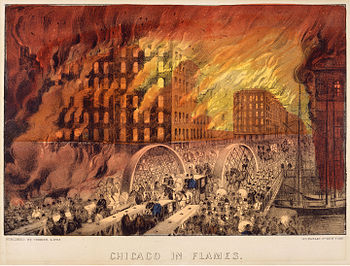 |
| The Great Chicago Fire destroys a large factory -Great Chicago Fire |
 |
| New York library burns to the ground in 1836 fire- Great Fire of New York |
The turn of the century was a time of incredible change. Through rapid urbanization and immigration; technology, sports, entertainment, and urban parks developed and flourished. The major downside of this rapid urbanization was the outbreak of a series of dangerous and horrifying urban fires, that ravaged cities and destroyed large neighborhoods all across America. A great source that gives a list of Great Fires in America from 1805 to 1890 shows that fires decimated large sections of Detroit, Washington D.C, Buffalo, New York City, Boston, Pittsburgh, St.Louis, San Francisco, Chicago, and Seattle. These fires costed millions of dollars in property damage, while leaving thousands of people homeless and hundreds of people dead. Something had to be done.
From the mid 1800’s to the early 1900’s, hundreds of thousands of immigrants poured into the United States from all corners of the world. They settled in large cities to live in communities with people of their same races and ethnicities. This caused a rapid growth of urbanization in the U.S, and while their were many positives to this, it became a major safety issue. An ABC-Clio article on Urban fires says that cities were forced to accommodate for the rapid population growth by building taller more flimsy buildings made out of wood and stacked up against each other. Because steel was still being used for railroads and new technology, the use of steel for building structure was very limited. This was a major fire hazard. The taller that buildings were stacked, the harder it became for the ameture firefighters to be able to douse the flames. And with urbanization forcing more and more people to be crammed into these musty tall buildings, the more likely it was for someone to start a fire that the underdeveloped fire departments could not not afford to, or have the skills to put out. A perfect example of this was the Great Chicago Fire in 1871. This was by far the worst ever urban fire catastrophe in American history. Like in most cities, the constant pollution from factories caused the air to be extremely dry and smoky. With Chicago being known as the infamous “Windy City”, there were strong winds blowing out of the southwest. And when a clumsy cow was believed to tip over a lantern in a barn, the flame ignited with the dry air and was strengthened by the wind. It traveled from one wooden building to another until all of Downtown Chicago was in flames, with the wood burning easily in the large blaze. A special edition New York Newspaper article from the day after the fire in Chicago, "New York Sun Newspaper" October 10, 1871, went into complete detail of the destruction caused by the great fire. Over 12,000 buildings were burned to the ground, all hotels and banks were destroyed, an estimated 60% of the city was destroyed, theatres and railroad depots were all destroyed, it claimed 250 lives and left 90,000 people homeless. Urbanization caused this problem, now urban residents had to come together like never before and come up with a solution to this problem.
In the mid 1800’s almost all Fire Departments in the United States consisted of ameture or volunteer factory men, who were not qualified or experienced enough to do the job correctly. An article about the Development of Municipal Fire Departments in The United States says that “In 1852, not one city in the United States paid it’s firemen, they were all volunteers.” For deadly and destructive fires that were causing millions of dollars in damage, this was a horrible way for cheap city planners to try and solve their fire outbreak problems. The city governments would not step in, to pay the costs for professional firemen, that would save hundreds of lives and buildings in their own cities. The citizens could not pay their taxes, let alone afford a professional fire department all on their own. The Crucible of fire book review, written by a firefighter by the name of Bruce Hensler stated that “Cities ended up with only the fire departments that they could afford, not the ones that they needed.” By the 1880’s, every single large U.S city had a professional fire department. So what changed? The review of an E-book called “Eating Smoke”,Eating Smoke review, says that insurance companies, city planners and basic taxpayers suffered from too many large portions of their cities being decimated by fires. In the past, people have always done things on their own and looked out for themselves. It has been the way of life since the beginning of time. But in this new age of large urban cities, that all changed. People knew that in a large city, they would have to come together to solve their problems in a way that was best for the community as a whole. That is where the true spirit of urbanization took place. People became fed up with the fire damages, so they came together as a community, and solved their problems by creating professional fire departments.
There are many ways that urbanization has made the world a better and more modern place. Urbanization was a direct cause of the tragic fires that decimated cities in the mid and late 1800’s. But in the end, the people of large cities came together through the true spirit of urbanization and solved the problem. Creating fire departments and city life as we know it today.
Tuesday, January 17, 2017
Peggy Wallace Kennedy's MLK speech
I thoroughly enjoyed Mrs. Kennedy's visit to our school. She reflected on painful memories in our countries civil rights past, and explained how her fathers negative role in the civil rights movement affected her life. She also gave a speech about Martin Luther, that anyone could have given, but it meant so much more when it came from someone whose last name had so much to do with civil rights. My favorite moment in her talk was when she told the story about her son burns visiting the civil rights museum with her. Her son was saddened, looking around the monuments, and finally asked why his grandfather did such terrible things. Mrs Kennedy's response was a great one. She told her son "We can't be held accountable for the family we were born into, but we can be responsible for the people we become". She made it clear that she had decided that it was up to her to change history and make everything right. That inspired me.

Subscribe to:
Comments (Atom)