1) Progress- Taking a step forward to achieving a goal
2) The progressive area was 1890-1920, it was a series of responses to social and economic problems.
Progressive reformists believed that these problems could be solved through widespread education and steady workflow with aid from the government. Their goal was to eradicate corporate greed.
3) Most reformists were college educated and lived in big cities.
4) Essential goals- Fighting poverty, racism, and corporate greed
Good goals- Creating safer work environments
Strange goals- Encouraging people to vote, setting up corporation regulations
Bad Ideas- Trying to get laws taken away to fit reform ideals.
Wednesday, February 8, 2017

Future research
In order to try and predict what the future will hold here in 2017, it is interesting to look at what predictions were like in the past. I researched what predictions were like 100 years ago, and then 50 years ago when there was more technology.
1) a. 100 years ago: My sources were Wired, and Smatterist.
People believed that: There would be flying taxis, robots would replace barbers, divers would ride sea horses, robots would clean kitchens, farming technology would be electric and run on cables, There would be an aviation police, schools would inject knowledge into students' brains through wires, and there would be torpedo planes.
b. 50 years ago: My source was Scientific American
People predicted automated ovens, cell phones, answering machines, travel to mars, roller-coasters, and the flat-screen T.V.
2) These predictions were more wishlists, than warnings. People were not really worried about technology that was coming, rather excited and hopeful for all of the strange things that they predicted.
3) Almost all of the predictions from 50 years ago were much more realistic and most came true. The predictions from 100 years ago were mostly bizarre and still very out of reach
4) The predictions from 100 years ago were very centered on travel both in the air and underwater. They also involved robots doing most common chores. The predictions from 50 years ago were much more realistic, and mostly centered around household improvements to phones and televisions.
5) In the future I can see time travel, cloning devices, hover crafts, travel to mars, and the discovery of life on another planet.
1) a. 100 years ago: My sources were Wired, and Smatterist.
People believed that: There would be flying taxis, robots would replace barbers, divers would ride sea horses, robots would clean kitchens, farming technology would be electric and run on cables, There would be an aviation police, schools would inject knowledge into students' brains through wires, and there would be torpedo planes.
b. 50 years ago: My source was Scientific American
People predicted automated ovens, cell phones, answering machines, travel to mars, roller-coasters, and the flat-screen T.V.
2) These predictions were more wishlists, than warnings. People were not really worried about technology that was coming, rather excited and hopeful for all of the strange things that they predicted.
3) Almost all of the predictions from 50 years ago were much more realistic and most came true. The predictions from 100 years ago were mostly bizarre and still very out of reach
4) The predictions from 100 years ago were very centered on travel both in the air and underwater. They also involved robots doing most common chores. The predictions from 50 years ago were much more realistic, and mostly centered around household improvements to phones and televisions.
5) In the future I can see time travel, cloning devices, hover crafts, travel to mars, and the discovery of life on another planet.
Thursday, February 2, 2017
Urban Fires
Crucible of fire book review- brucehensler.typepad.com- I used this source to gain perspective about the life of a firefighter, and the history of how fire departments developed in urban communities
Eating Smoke review- eh.net/book- I used this source to find information on how urban fires were affecting large cities in the late 1800's
Great Fires- historylectures.com- I used this source to gather a list of urban fires, to use as examples in my paper, and also as search tools to find additional information about urban fires.
"New York Sun Newspaper" October 10, 1871- I used this newspaper article as a primary source, to gain perspective on what it was like to live in cities during these times.
Development of Municipal Fire Departments in The United States- I used this article to gather information about the effects that urbanization had on the development of professional fire departments
Urban fires- ABC-Clio- I used this article to sum up my other research, and try to gather more information about urban fires and fire departments
 |
| Downtown San Francisco goes up in flames after earthquake- San Francisco earthquake |
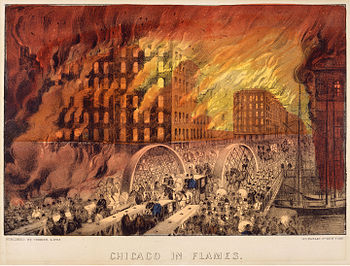 |
| The Great Chicago Fire destroys a large factory -Great Chicago Fire |
 |
| New York library burns to the ground in 1836 fire- Great Fire of New York |
The turn of the century was a time of incredible change. Through rapid urbanization and immigration; technology, sports, entertainment, and urban parks developed and flourished. The major downside of this rapid urbanization was the outbreak of a series of dangerous and horrifying urban fires, that ravaged cities and destroyed large neighborhoods all across America. A great source that gives a list of Great Fires in America from 1805 to 1890 shows that fires decimated large sections of Detroit, Washington D.C, Buffalo, New York City, Boston, Pittsburgh, St.Louis, San Francisco, Chicago, and Seattle. These fires costed millions of dollars in property damage, while leaving thousands of people homeless and hundreds of people dead. Something had to be done.
From the mid 1800’s to the early 1900’s, hundreds of thousands of immigrants poured into the United States from all corners of the world. They settled in large cities to live in communities with people of their same races and ethnicities. This caused a rapid growth of urbanization in the U.S, and while their were many positives to this, it became a major safety issue. An ABC-Clio article on Urban fires says that cities were forced to accommodate for the rapid population growth by building taller more flimsy buildings made out of wood and stacked up against each other. Because steel was still being used for railroads and new technology, the use of steel for building structure was very limited. This was a major fire hazard. The taller that buildings were stacked, the harder it became for the ameture firefighters to be able to douse the flames. And with urbanization forcing more and more people to be crammed into these musty tall buildings, the more likely it was for someone to start a fire that the underdeveloped fire departments could not not afford to, or have the skills to put out. A perfect example of this was the Great Chicago Fire in 1871. This was by far the worst ever urban fire catastrophe in American history. Like in most cities, the constant pollution from factories caused the air to be extremely dry and smoky. With Chicago being known as the infamous “Windy City”, there were strong winds blowing out of the southwest. And when a clumsy cow was believed to tip over a lantern in a barn, the flame ignited with the dry air and was strengthened by the wind. It traveled from one wooden building to another until all of Downtown Chicago was in flames, with the wood burning easily in the large blaze. A special edition New York Newspaper article from the day after the fire in Chicago, "New York Sun Newspaper" October 10, 1871, went into complete detail of the destruction caused by the great fire. Over 12,000 buildings were burned to the ground, all hotels and banks were destroyed, an estimated 60% of the city was destroyed, theatres and railroad depots were all destroyed, it claimed 250 lives and left 90,000 people homeless. Urbanization caused this problem, now urban residents had to come together like never before and come up with a solution to this problem.
In the mid 1800’s almost all Fire Departments in the United States consisted of ameture or volunteer factory men, who were not qualified or experienced enough to do the job correctly. An article about the Development of Municipal Fire Departments in The United States says that “In 1852, not one city in the United States paid it’s firemen, they were all volunteers.” For deadly and destructive fires that were causing millions of dollars in damage, this was a horrible way for cheap city planners to try and solve their fire outbreak problems. The city governments would not step in, to pay the costs for professional firemen, that would save hundreds of lives and buildings in their own cities. The citizens could not pay their taxes, let alone afford a professional fire department all on their own. The Crucible of fire book review, written by a firefighter by the name of Bruce Hensler stated that “Cities ended up with only the fire departments that they could afford, not the ones that they needed.” By the 1880’s, every single large U.S city had a professional fire department. So what changed? The review of an E-book called “Eating Smoke”,Eating Smoke review, says that insurance companies, city planners and basic taxpayers suffered from too many large portions of their cities being decimated by fires. In the past, people have always done things on their own and looked out for themselves. It has been the way of life since the beginning of time. But in this new age of large urban cities, that all changed. People knew that in a large city, they would have to come together to solve their problems in a way that was best for the community as a whole. That is where the true spirit of urbanization took place. People became fed up with the fire damages, so they came together as a community, and solved their problems by creating professional fire departments.
There are many ways that urbanization has made the world a better and more modern place. Urbanization was a direct cause of the tragic fires that decimated cities in the mid and late 1800’s. But in the end, the people of large cities came together through the true spirit of urbanization and solved the problem. Creating fire departments and city life as we know it today.
Subscribe to:
Comments (Atom)